Bet on Poker
Six hands on the felt, one deck, and not a single card that belongs to you. That is the strange, addictive setup behind Playtech’s live poker betting table. Nobody folds, nobody bluffs, nobody stares down the dealer. The cards fall, the prices move, and the only decision that matters is where the money goes before the next window closes.
For anyone who grew up on sportsbook markets and then wandered into a live casino lobby, this table feels instantly familiar. There is a bet slip. There are odds that drift. There are singles, doubles and trebles. The difference is that the “match” lasts a little over two minutes and the “players” are six anonymous poker hands laid out on green baize under studio lights.
This review breaks the game down properly: rules, numbers, the odds board, payout ceilings, interface quirks, the tricks regulars use, and the things that quietly eat a bankroll when nobody is paying attention. It is written for people who intend to sit down and play, not for people who want a brochure.

Release Date
2021

Provider
Playtech

Game Type
Live

RTP
95.25–96%

| Feature | Detail |
| 🎲 Game type | Live dealer card betting game |
| 🏢 Provider | Playtech Live |
| 📅 Wide rollout | 2021 |
| 🃏 Deck | Single 52-card deck, reshuffled each round |
| 👥 Hands dealt | 6 face-up seats |
| 🎯 Individual markets | 27 |
| 🔗 Combination bets | Singles, doubles, trebles |
| ⏱️ Round length | Approx. 2 min 20 sec |
| ⌛ Betting windows | 3 per round, roughly 25 sec each |
| 📈 RTP range | 95.25% – 96% |
| 🌪️ Volatility | Medium on hand bets, high on suits and long-shot combos |
| 💰 Min bet | From €/$0.10 – 1 depending on operator |
| 💵 Max bet | Commonly €/$500 – 1,000+ per market |
| 🏆 Longest headline price | Straight Flush, around 613.00 |
| 🎨 Second longest | All community cards same suit, around 484.00 |
| 📱 Mobile support | iOS, Android, mobile browsers |
| 💻 Desktop support | Windows, macOS, no download needed |
| 🖥️ Studio | Playtech live studio floor, multi-camera HD |
| 🗣️ Chat | Dealer chat and support chat |
| 📊 Statistics | Round history, results archive, bet slip log |
| ⚡ Quickbet | Yes, one-tap staking |
| 🔁 Autoplay | Not available — live windows only |
| 🌍 Interface languages | Multiple, including English, Spanish, Portuguese |
| 🔒 Licensing | UKGC, MGA and other regulated jurisdictions |
| 📺 Streaming | Low-latency HD with close-up card cams |
Play the demo Bet on Poker for free
List of the best casinos for playing Bet on Poker
 | Bet365 | Claim a 100% deposit match up to $1000 and qualify for up to 1000 free spins. | 9.62 | ; |
 | 1WIN | Get a 500% bonus on your first four deposits up to $1025 total. Download the app for an additional $100 sports betting bonus. | 9.54 | ; |
 | BetWinner | Use a promo code for a 100% bonus up to $1630 and 150 free spins. | 9.43 | ; |
 | Mostbet | Get a 125% first deposit bonus up to $400 and 250 free spins. | 9.31 | ; |
 | 888 Casino | Get 88 free spins with no deposit required, followed by a 100% match up to $520. | 9.26 | ; |
 | Brazino777 | Claim a 225% welcome package up to $5000 over three deposits. High rollers can access a special 200% match up to $30000. | 9.18 | ; |
 | Bwin | Provides a 100% deposit match up to $108 and a $25 risk-free "Backup Bet" for sports. | 9.04 | ; |

| Pin-up | Receive a 120% first deposit bonus up to $500 plus 250 free spins | 8.92 | ; |
 | 1xBet | New users get a 300% welcome bonus up to $600 split between sports and games. | 8.76 | ; |
| RedKings | Receive a 100% match up to $100 plus 15 free spins on your first deposit. | 8.49 | ; |
 | Pinco | Claim a 150% first deposit bonus up to $3650 and 250 free spins with a standard 50x wagering requirement | 8.32 | ; |

| Melbet | Claim up to $1750 and 290 free spins over five deposits with a minimum deposit of $11. | 8.21 | ; |
Bet on Poker — Full Review of Playtech’s Live Card Betting Table
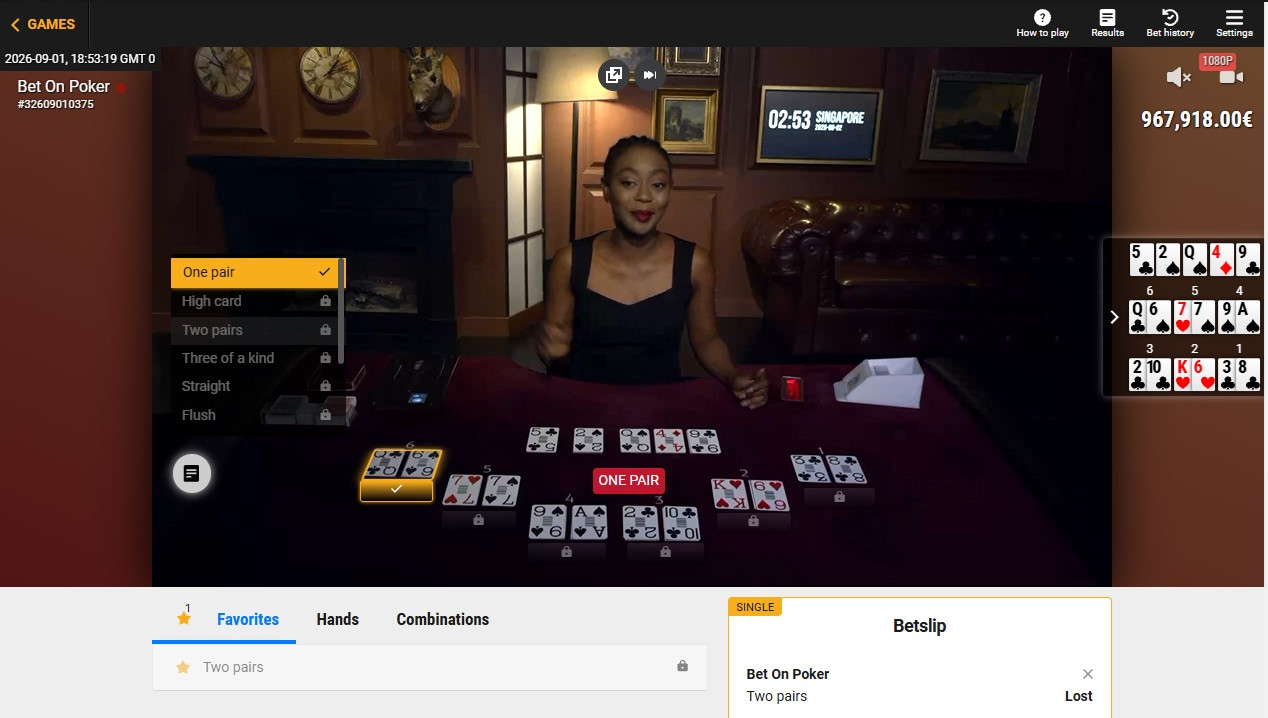
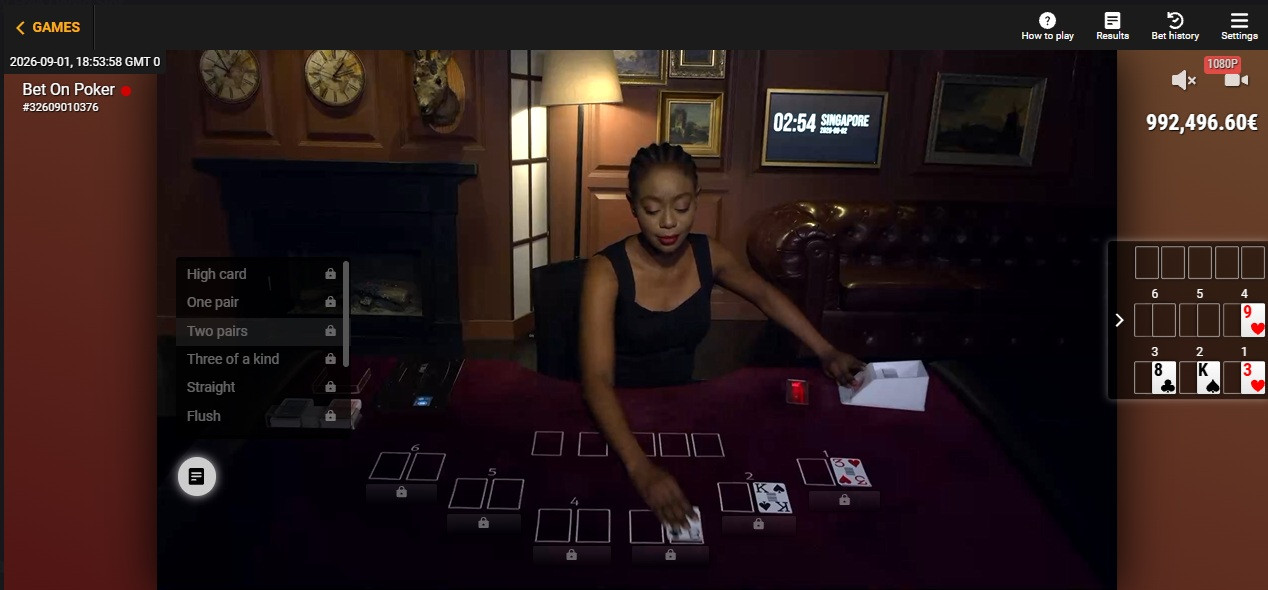
Playtech built this title for a very specific crowd — the crossover player. Someone who bets football on Saturday, dabbles in roulette on Sunday, and wants something in between. A live dealer shuffles a single 52-card deck, deals two cards face-up to six seats, then runs a standard Texas Hold’em board: flop, turn, river. No seat is yours. No decisions are made by the hands. They simply exist, and the best five-card combination on the table at showdown decides which markets pay.
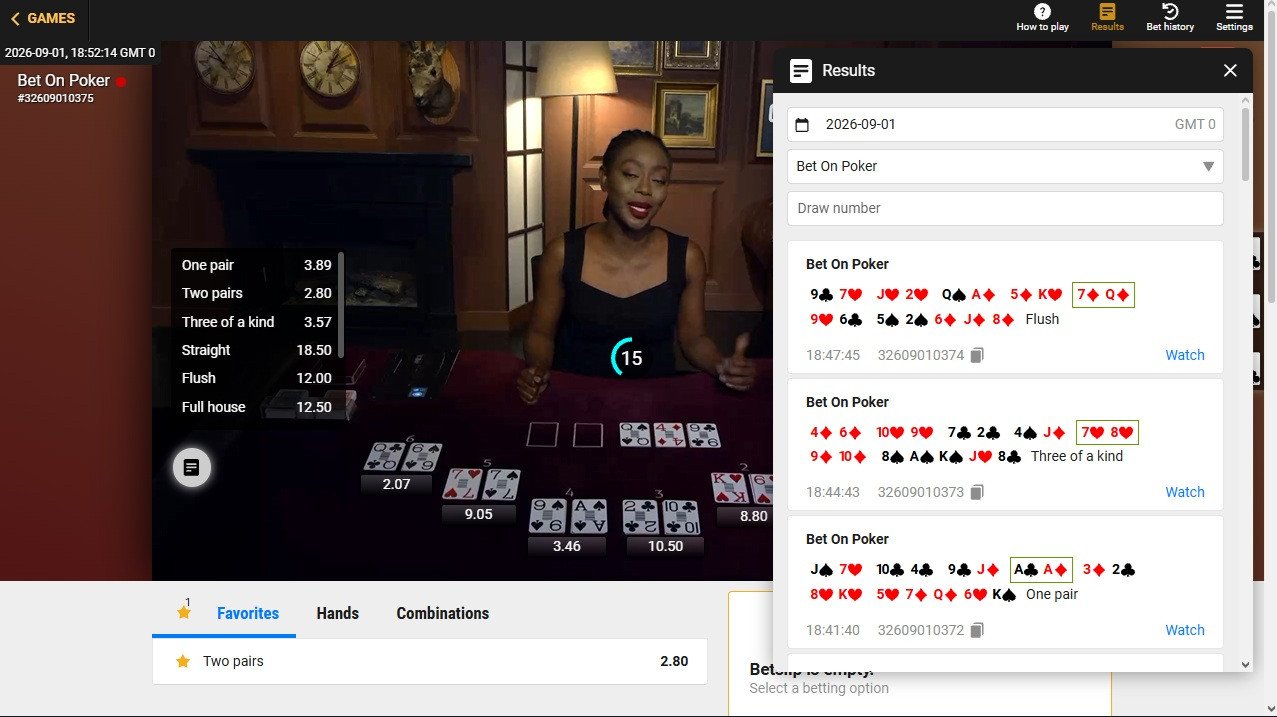
Visually, the studio keeps things grown-up. Deep green felt, warm overhead lighting, a dealer in a dark waistcoat, a camera rig that cuts to a close-up as each card lands. No cartoon mascot, no confetti cannon, no wheel spinning in the corner. The mood sits between a private poker room and a betting shop screen — clean, slightly serious, built to be watched rather than gawped at. The audio is deliberately thin: shuffling cards, chips, the dealer calling the action. The cues for closing windows, though, are worth keeping unmuted.
Pace is the first thing regulars mention. A full round runs about two minutes and twenty seconds from shuffle to payout — slow by roulette standards, glacial next to a crash game. That is the whole point. Those two minutes hold three separate betting windows of roughly twenty-five seconds each, with prices recalculated before every one. Information arrives in stages, the market reprices, and the player either acts on the new picture or sits on their hands. That rhythm pulls sportsbook people in and bores pure card players stiff.
One thing needs setting straight early: this is not poker in the competitive sense. No dealer hand to beat, no ante, no fold button. The house is not an opponent — it is a bookmaker quoting prices.
Bet on Poker RTP Explained
RTP — return to player — is the long-run percentage of everything wagered that flows back to players. A 96% figure means that across a colossal number of rounds, the table is designed to hand back roughly 96 units for every 100 staked. It is a theoretical average, not a promise, and it says absolutely nothing about what happens in the next twenty minutes. Two players can sit at the same table on the same night and walk away with wildly different results while the math behind the scenes stays exactly where it always was.
Here the published range sits between 95.25% and 96%, and that spread matters more than the headline number. This is not a slot with one fixed figure baked into the code. Every market carries its own edge. The straightforward stuff — betting on which of the six seats takes the pot, or backing red or black on the turn card — sits toward the friendlier end. The exotic material, the long-shot suit patterns and the deep trebles, is where the house edge fattens up. Anyone chasing the best return should treat the odds board like a menu with prices on it, because that is exactly what it is.
Compared to the rest of the live poker family, this figure is honest rather than spectacular. Casino Hold’em and Ultimate Texas Hold’em both return more to players who follow correct strategy, and nobody serious pretends otherwise. What those games do not offer is twenty-seven simultaneous markets, moving prices, and the ability to stack three predictions into one payout. The trade is comfort for optionality. Players who want the mathematically kindest card game in the lobby should walk past this table. Players who want a market to trade for two minutes at a time are in the right room.
There is a practical wrinkle too. Since odds refresh before every window, the value of a wager depends on when it was struck. A price taken blind before the deal is worth something different from the same outcome backed after the flop, when half the deck’s story is visible. Regulars think in terms of the price they took, not the RTP of the game — and that mental shift is the biggest upgrade available to anyone arriving from slots.
Bet on Poker Max Win Potential
There is no jackpot symbol and no max multiplier plastered across the lobby tile, which throws people at first. The ceiling here is built out of odds, not a bonus round. The longest headline price belongs to a Straight Flush landing as the winning hand — around 613 to 1 before any cards are dealt. Behind it sits the market on all five community cards arriving in one suit, opening near 484 to 1, with Four of a Kind hovering around 108 to 1. Those long shots are why people keep the tab open.
The real ceiling, though, comes from combinations. A treble stacks three predictions into one wager, and the odds multiply rather than add. Back a specific seat at 5.79, pair it with the winning hand being a Flush at 8.86, then add the flop landing all one suit at 18.54, and the combined price runs into five figures. All three legs must land — miss one and the whole ticket dies — but the arithmetic is what turns a modest stake into a headline. This is the closest thing the table has to a bonus feature, and it is entirely player-built.
Two guardrails apply. Every operator sets a maximum payout per ticket, written into the terms rather than the game rules, and that cap varies enormously between casinos. And prices tighten as information arrives: a Flush market quoted at 8.86 before the deal collapses once the flop shows three hearts, because the outcome is suddenly likely. The fat prices live in uncertainty. Waiting for safety and waiting for value are opposite instincts, and this table punishes anyone who confuses the two.
Realistically, most winning sessions here are built out of singles at modest odds and the occasional double that lands. The 613s exist, they get hit, and the history log proves it. They are simply not a plan.

Where This Table Sits in the Lobby
Category confusion is the most common complaint from newcomers. People search the poker section, expect to play cards, and find a bet slip instead. This is a betting product wearing a poker costume, and it belongs mentally next to virtual sports and bet-behind formats rather than next to Casino Hold’em. That positioning also explains where it appears: far more often at operators running a serious sportsbook alongside their casino, since that is the audience it was built to poach. Hunting for the table? Start with hybrid brands rather than pure slot sites.
Gameplay and Interface: How a Round Actually Runs
Everything begins with a fresh shuffle. The dealer breaks a new 52-card deck every round, which kills any card-counting angle before it starts. Each round is a clean, independent event — worth internalising early, because a surprising number of newcomers arrive convinced deck tracking is the edge here.
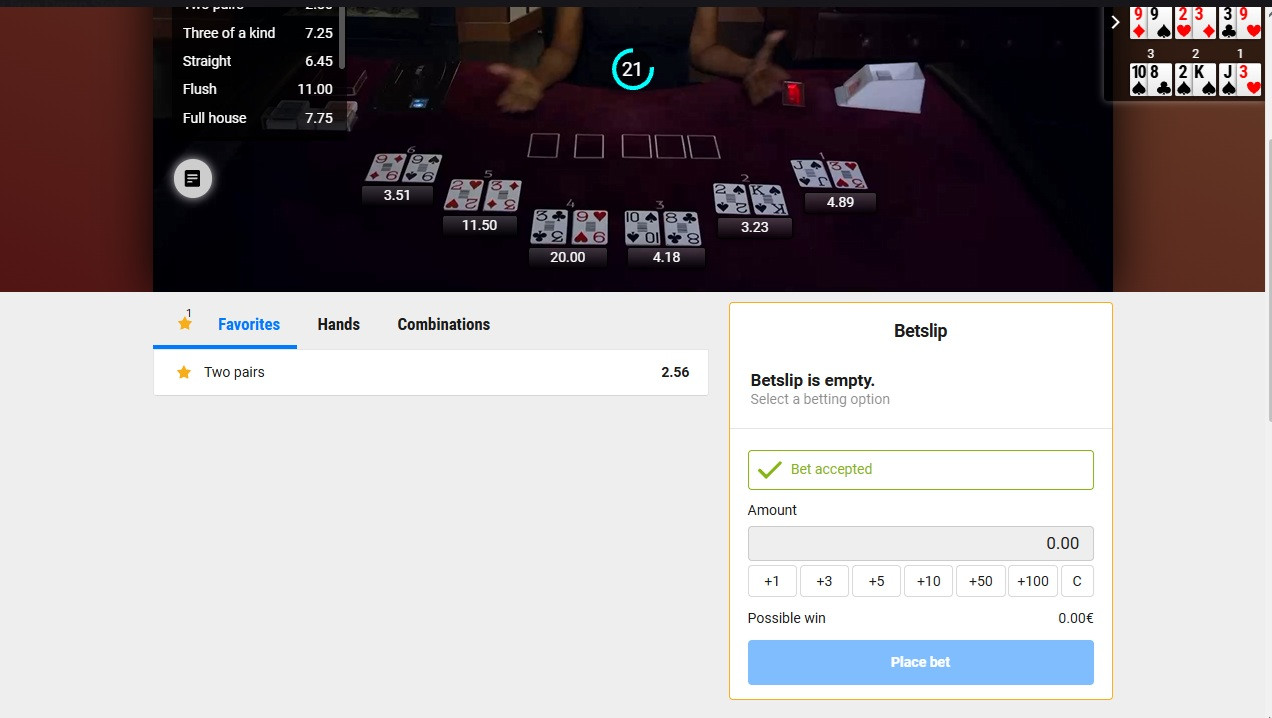
The first betting window opens before a single card is exposed. Twenty-five seconds, blank table, full odds board. All six seats are quoted at roughly 5.79, which is the first quiet lesson of the game: six equal outcomes should price at 6.00, and they do not. That gap is the house edge, sitting in plain sight. Backing a seat at this stage is pure coin-flipping with a small tax attached, and most regulars leave the hand markets alone until they can see something. What does make sense before the deal is the abstract stuff — what shape the winning hand will take, whether the flop runs red or black, whether the community cards share a suit. Those outcomes are not affected by which seat gets which cards.
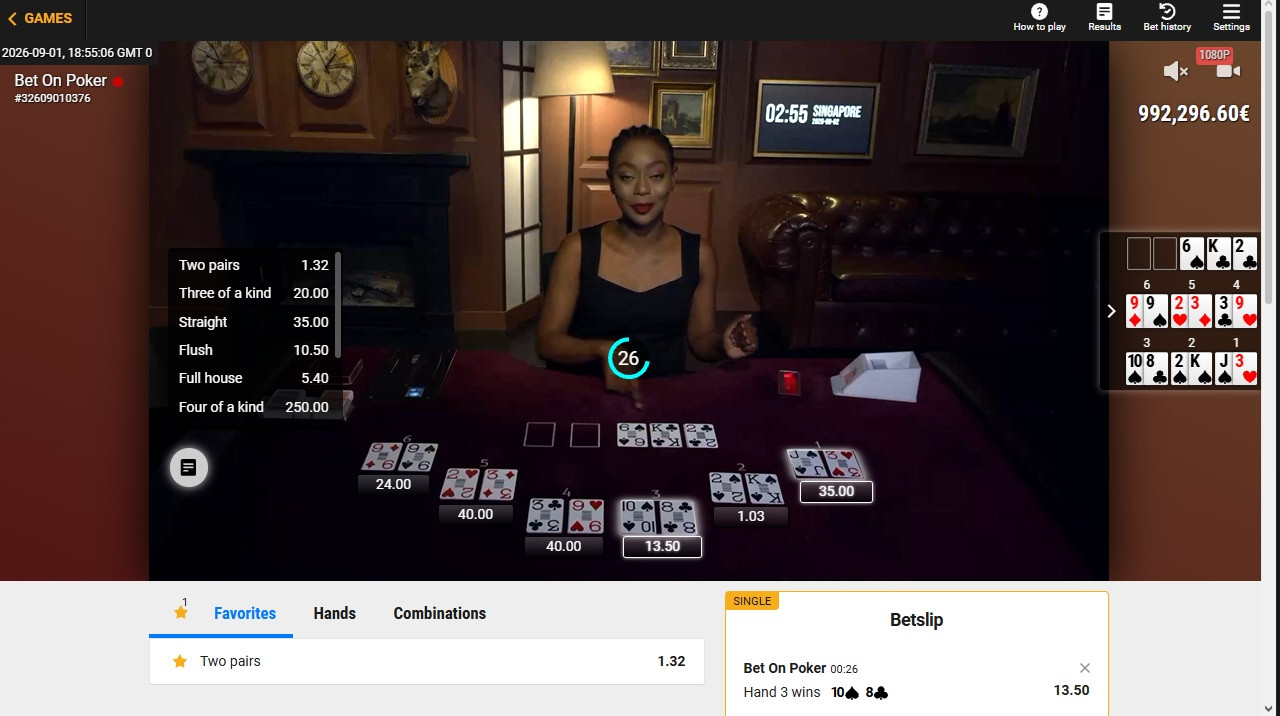
Then the cards land. Two face-up to each of the six positions, camera dipping in close so nobody has to squint. The board reprices instantly: a seat holding a big pair is no longer 5.79, it might be 3.20, while a seat holding rags drifts out to double figures. Betting reopens for another twenty-five seconds, and this is where the game starts to breathe. There is real information now, the prices reflect it — but not perfectly. Gaps appear. Finding them is the entire craft.
The flop follows, three community cards across the middle, shared by all six seats. Prices move again, usually violently. A hand that looked strong pre-flop can be crushed; a scruffy 7-2 can suddenly be sitting on trips. The third and final betting window opens here, and it is the most informed moment of the round. Two cards left to come, most of the picture visible, and combination bets become far more constructible. After that, the turn and river arrive back to back, the best five-card hand is determined, and the payouts run.
The interface splits into three panels — hand markets, hand-value combinations, suits and colours — which sounds cluttered and settles quickly. Tap a market, a stake box appears, confirm, and the wager drops into the bet slip like a sportsbook ticket. Bets can be pulled back while the window is open, which saves plenty of mis-taps. Quickbet pre-assigns a default stake so a market can be backed in a single touch, and phone players should set it up immediately.
The one honest gripe, echoed across player forums, is the results display. The winning hand is highlighted briefly and then vanishes. In a game where trips on the board and trips as the winning hand are two different things, that flash is not enough. The history panel holds the full detail, so a workaround exists — it just costs an extra tap at the exact moment clarity matters most.

Betting Markets and Payouts: The Full Board
Instead of reels and symbols, this table hands players a board of twenty-seven individual markets, split into three families. Knowing which family is being touched is the difference between informed betting and stabbing at coloured rectangles.
Hand Position Markets
The simplest bets on the table. Six seats, one winner, back the one expected to take the pot at showdown. Opening prices sit around 5.79 across the board and then swing hard as cards appear. These markets are the backbone of the game and the easiest entry point for anyone new to it.
The catch is that the winning hand means the best five-card combination at showdown, hole cards plus shared board. Kickers matter. A seat holding a pair of nines that ends up playing the board is not a winner just because it looked pretty pre-flop. Anyone who has played Hold’em socially reads these spots instinctively; anyone who has not should watch a few rounds before staking.
Hand Value Markets
These bets ignore who wins and ask what the winning hand will be. Two Pair, Pair, Three of a Kind, Straight, Flush, Full House, Four of a Kind, Straight Flush. The prices tell an honest statistical story about how often each shape actually takes down a six-handed pot.
| Winning hand market | Typical opening price | Reality check |
| Two Pair | ~3.14 | The workhorse. Wins more six-handed pots than anything else |
| Pair | ~5.95 | Common in dry, disconnected boards |
| Straight | ~5.78 | Needs the board to cooperate, but appears constantly |
| Three of a Kind | ~6.90 | Solid middle ground, decent value post-flop |
| Full House | ~8.78 | Loves paired boards — watch for them |
| Flush | ~8.86 | Two suited community cards make this live |
| Four of a Kind | ~108.00 | Rare, and rarely worth chasing blind |
| Straight Flush | ~613.00 | The headline number, and a genuine lottery ticket |
The trap in this family is subtle and catches almost everyone once. Backing “Three of a Kind” does not pay because trips appear somewhere on the table. It pays only if trips is the best hand at showdown. If another seat quietly turns a Full House, the ticket is dead even though the prediction was technically correct. Winning hand means winning hand — nothing else.
Suits and Colours Markets
The purest gambling on the board, and the family that requires no poker knowledge whatsoever. Only an understanding of what lives inside a deck of cards.
Turn card red or black — coin-flip territory, priced around 1.92
River card red or black — same shape, same price
Flop all red or all black — around 8.15, and genuinely thrilling to watch land
Flop all one suit — around 18.54
Flop three different suits — around 2.41, the safe end of the family
Turn and river matching suits — around 4.07
All five community cards red or black — around 37.92
All five community cards one suit — around 484.00, and about as likely as it sounds
These markets are the reason the game holds people who do not know a flush from a full house. They are transparent, fast to evaluate, and completely immune to any misreading of poker hands.

Combination Bets
Every market above can be stacked. Doubles combine two predictions, trebles combine three, and the odds multiply. All legs must land. The system is lifted straight from sportsbook accumulators, and it behaves the same way — the payouts look glorious and the strike rate is brutal.
The clever application is a post-flop double linking a seat to a hand value — backing seat four to win and the winning hand to be a Flush, when seat four holds the only two hearts on a two-heart board. Both legs rise and fall together. Correlated legs are the sharp play; random legs stapled together for a bigger number are how bankrolls disappear.
Special Features and In-Game Tools
No free spins, no wheel, no mystery multiplier dropping from the ceiling. The features here are functional rather than theatrical, built around one idea: letting a bettor act fast and act late.
Dynamic odds are the headline mechanic. Prices recalculate before every window based on what is genuinely still possible, and any market that can no longer win is greyed out and closed. That means the board is always a live probability map rather than a static paytable. Watching how far a seat drifts after an ugly flop teaches more about poker equity in ten rounds than most strategy articles manage in ten pages.
Quickbet is the tool that separates comfortable players from flustered ones. Assign a default stake, and every market becomes a single tap. On a phone, with twenty-five seconds on the clock and a flop that has just changed everything, that setting is worth more than any strategy tip.
The bet slip and history archive round things out. Live tickets stack on screen with the price each was struck at, so a player sees exactly what they backed and when. Completed rounds are stored with full showdown detail — the place to go when a result looks confusing. Moderated dealer chat covers the social side.

Awards, Ratings and Industry Reception
Playtech has spent years collecting silverware — EGR Awards, Global Gaming Awards nominations, a long list of B2B recognitions for its live studio operation. This particular table was never marketed as an award-chaser in its own right, and any review claiming it swept a trophy cabinet is inventing things. What it earned instead is a specific, well-defined reputation.
Among live casino reviewers the consensus is steady: technically clean, genuinely original, slower than its own audience would like. Ratings land in the 7 to 8 out of 10 band. Praise clusters around betting depth and the honest presentation of dynamic odds; criticism around round length and the disappearing results display. Few reviewers hate it, few call it their daily table.
Player sentiment splits along one clean line. Sportsbook crossovers rate it highly and stay for months; card players who wanted decisions of their own tend to leave after a session or two. That is not a flaw — it is the game working as designed.
Is Bet on Poker Legal and Fair?
Short answer: yes, wherever online gambling itself is legal. This is a regulated product from Playtech, one of the most heavily audited software suppliers in the industry, and it operates under the same licences as every other table in a Playtech live lobby. Playtech holds a UK Gambling Commission account and a Malta Gaming Authority B2B licence, alongside authorisations across a range of regulated markets.
Fairness rests on something refreshingly simple: physical cards, a real dealer, a camera. No random number generator decides outcomes here — a fresh deck is shuffled and dealt on stream, in view, every round. Studio procedures cover shuffling, card recognition and dealer conduct, while independent testing houses audit the wider platform, including the odds engine behind the prices.
Legality on the player’s side is a matter of local law and age, not of the game itself. Licensed operators enforce identity checks and territory restrictions, and jurisdictions that block online casino play block this table along with everything else. Responsible gambling tools — deposit caps, loss limits, session reminders, self-exclusion — come as standard, and on a table with three betting windows per round, limits are not a formality. They are useful furniture.
How to Play: Practical Tips and Player Hacks
The core loop is easy: watch the cards, read the board, back an outcome before the window shuts. Getting good takes more. Learn poker hand rankings properly — including how kickers break ties. Half the losing tickets here are not bad bets, they are correct predictions attached to a misread showdown.
Skipping rounds is a legitimate strategy and a surprisingly powerful one. Nothing forces a bet in any window; a player can join mid-round, sit out, or wait for a board texture worth backing. The bettors who last treat no bet as an active choice rather than a wasted two minutes.

Seven Hacks Regulars Actually Use
Leave the pre-deal hand markets alone. Six blind outcomes priced at 5.79 is a coin-flip with a fee attached. If a bet must go on before the deal, use hand-value or suit markets instead — those outcomes do not depend on who is holding what.
Set Quickbet before the first round, not during it. Twenty-five seconds disappears alarmingly fast on a phone, and fumbling a stake box while the flop is repricing is how good reads turn into no bets.
Hunt paired boards for Full House value. The moment two matching ranks hit the community cards, the Full House market becomes live and often stays priced generously for a beat before the board catches up.
Correlate the legs of every double. Linking a seat to the hand value that seat is drawing to means both legs win together. Stapling unrelated markets into a treble purely for a bigger number is not strategy, it is decoration.
Take the two-suit flop seriously. Two hearts on the flop transforms the Flush market from a long shot into a live contender, and the price rarely adjusts as sharply as the actual probability does.
Read the history panel after every big round. It is the only place the full showdown detail lives. Ten minutes spent there teaches which board textures produce which winners — that is a real edge, and it is free.
Bank the session, not the round. Round length is over two minutes, which means an hour is roughly twenty-five rounds. Setting a stop-loss and a walk-away number in advance matters far more here than at a fast table, because slow games disguise how much has been staked.
About the Developer: Playtech
Founded in 1999 in Tartu, Estonia, Playtech grew from a small software outfit into one of the largest listed gambling technology companies anywhere, trading on the London Stock Exchange and supplying platforms, casino content, live tables, poker, bingo and sportsbook technology worldwide. Scale is the defining trait — few suppliers run a slot studio, a live floor and a sportsbook back end under one roof.
That breadth explains this table’s existence. Playtech does not just build casino games; it builds the betting engines that sit behind sportsbooks. Somebody inside the company looked at two audiences that rarely met — the poker crowd and the accumulator crowd — and asked what would happen if a card game were used as raw material for a betting market instead of as a contest. The result was a small family of “bet on” formats, with poker and baccarat as the flagships, all built on the same principle: deal the cards, price the outcomes, let the punter trade.
Production runs out of Playtech’s studio operation, with its major hub in Riga and regional floors serving localised markets: multi-camera setups, professional dealers, low-latency streaming, dedicated tables for individual brands. For this title the studio work is understated on purpose. The camera exists to show cards clearly and keep the odds board legible — no gimmicks, no spinning sets, no shouting hosts. It suits a game where the drama lives in the prices rather than the presenter.
Reading the Odds Board Like a Bettor, Not a Gambler
Here is the insight that separates people who enjoy this table from people who bleed on it: the odds are the product. Everything else — the felt, the dealer, the cards — is scenery. Learning to read how prices move is the whole game.
Prices reprice three times a round, and every reprice carries information. A seat still sitting at 5.79 after the deal is holding nothing special; a seat that collapses to 2.80 is holding something the engine respects. But the engine prices raw equity, and equity is not the story the board is about to tell. A big pair carries enormous pre-flop equity and can be functionally dead the instant three connected cards land — and for a beat, that mismatch is visible to a human before the next window opens.
That is where the value hides. Not in guessing, but in spotting the moment when the visible board and the standing price disagree. The three-window structure exists precisely because information arrives in chunks, and the player who has already worked out what a flop means while everyone else is still looking at their hole cards is the player getting the better number.
The counterweight is discipline. Long prices exist because the outcomes are unlikely, and a 484.00 quote is not a bargain — it is an accurate reflection of a very rare event. Bettors who last treat the board as a market with commission built in, take the prices that look wrong, and let the rest run past. Slow, unglamorous, functional.
How This Table Compares to Other Live Poker Formats
Anyone shopping the live poker section deserves an honest comparison, because these games are not interchangeable and the RTP gaps are real.
| Live poker format | Typical RTP | What the player actually does | Best suited to |
| Bet on Poker | 95.25% – 96% | Backs outcomes across 27 markets in three windows | Sportsbook bettors who like accumulators |
| Casino Hold’em | ~97.8% | Plays a hand, calls or folds against the dealer | Card players wanting real decisions |
| Ultimate Texas Hold’em | ~99.5% | Bets in stages against the dealer, strategy-heavy | Value hunters who study charts |
| Casino Stud Poker | ~96.3% ante | Beats the dealer’s five-card hand, jackpot side bet | Players chasing a progressive |
| Video Poker Live | up to ~99.5% | Holds and draws against a paytable | Solo grinders who want maximum RTP |
That table is context, not a hit piece. Nobody should be sold the idea that this is the mathematically optimal way to play cards in a live casino, because it plainly is not. What the comparison also shows is that every higher-RTP alternative asks the same thing over and over: one decision, one dealer, one hand. This game asks something else entirely, and for a certain kind of brain, twenty-seven live markets and a moving price board are worth a percentage point of theoretical return. A preference, not a mistake — as long as it is made with eyes open.
What Players Say
Feedback from forums, comment threads and casino review sections lands with unusual consistency. The praise is specific, the frustration is specific, and almost nobody is lukewarm.
Tomasz K. — “Came from football accas, stayed for the trebles. Backing a seat plus the hand value after the flop is the most fun bet in any casino lobby, full stop.”
Priya R. — “Two minutes a round felt like forever at first. Now it’s the reason it’s on my phone — there’s actually time to think instead of panic-clicking.”
Marcus D. — “Lost a ticket because I backed trips, trips were on the board, and someone made a boat. Learned that lesson once. Read the rules on winning hands before you deposit.”
Sofia B. — “The colour bets are what got my partner playing. She doesn’t know a straight from a flush and she doesn’t need to. Red or black on the river, done.”
Kenji T. — “Quickbet is not optional on mobile. Set it up or you’ll miss half your bets.”
Diego A. — “Wish the winning hand stayed on screen longer. The history tab has everything, but you shouldn’t have to dig for it every round.”
Fiona M. — “Best table in the lobby for watching with a drink and betting small. Terrible table if you want to grind fast.”
The Balance Sheet
| Strengths | Trade-offs |
| ✅ 27 live markets, far more choice than any rival poker table | ⚖️ Round length of 2m20s suits patient players, not fast ones |
| ✅ Dynamic odds that reprice with real information three times a round | ⚖️ Results display is brief — full detail requires opening the history panel |
| ✅ Combination bets deliver serious payout potential from small stakes | ⚖️ Not available at every Playtech casino, mostly sportsbook-led brands |
| ✅ Suit and colour markets are playable with zero poker knowledge | |
| ✅ No decisions to misplay — no strategy chart required to avoid leaking RTP | |
| ✅ Genuinely fair setup: real cards, real dealer, fresh shuffle every round | |
| ✅ Clean, sober studio production with excellent close-up camera work | |
| ✅ Slow pace makes bankroll control far easier than on rapid-fire tables |
What the Experts Say
Dr. Aleksandra Vukić, gambling mathematics researcher: “The most instructive thing about this format is that it makes the house edge visible. Six equal outcomes quoted at 5.79 instead of 6.00 tells a player exactly what they are paying, in a way a slot’s RTP figure never does. It is unusually honest architecture.”
Rasmus Lindqvist, live casino product analyst: “Playtech solved a real problem here. Live poker tables historically struggled to hold sportsbook customers because those players do not want to make decisions — they want to price them. This format hands them a market and gets out of the way.”
Chidi Okonkwo-Bailey, iGaming content strategist: “The failure mode is entirely predictable. Players who treat the combination bets like a lottery ticket rather than a correlated position will lose faster than they expect. The tool is fine. The habit is the problem.”
Marisol Etxeberria, responsible gambling consultant: “A slower round is a genuine protective feature, but it can also disguise volume. Three betting windows in one round means a two-minute game can carry more turnover than a thirty-second spin. Session limits matter here more than the clock suggests.”
Final Verdict
This is not the highest-RTP card game in a live casino lobby, and any review pretending otherwise is doing nobody a favour. What it is instead is the most genuinely original one — a live poker table that quietly turns into a betting exchange, where the cards are raw material and the odds board is the actual playing field.
The appeal is easy to name. Twenty-seven markets, prices that move three times a round, combination bets that can turn a small stake into something worth screenshotting, and colour bets anyone understands within thirty seconds. Production is clean, dealing is transparent, and the fairness question answers itself with a fresh deck and a camera.
It rewards patience, punishes impatience, and asks players to think in prices rather than hands. For sportsbook regulars curious about the casino floor — and for card players who fancy trading a market instead of playing a hand — few tables offer more to chew on. Set a limit, learn the hand rankings, leave the blind bets alone, and it earns its place in the rotation.


The most important questions and answers about the game Bet on Poker
Six seats with an equal chance of winning would price at exactly 6.00 in a fair market. The 5.79 quote is the house margin, sitting in plain sight before a single card is dealt. That gap is the cost of the blind bet, which is why most regulars leave the pre-deal hand markets alone and wait until real information reaches the table.
Yes. Nothing forces a bet in the first window, and a player can walk in after the hole cards or even after the flop and still get action. Each of the three betting windows accepts fresh wagers at the prices showing at that moment. Sitting out an entire round costs nothing, which makes selective, patient betting a completely valid way to approach the table.
No, and this catches almost everyone once. Hand-value markets settle on the best five-card combination at showdown, not on what merely appears somewhere on the felt. If trips are present but a rival seat quietly makes a Full House, the ticket loses. The prediction has to describe the winner, not just something visible on the table.
Standard poker rules apply. The kicker card decides between two hands of equal rank, and with a Full House the higher three-card set takes precedence, with the pair used as a tiebreaker. Because the interface flashes the showdown result briefly, the history panel is the reliable place to check exactly how a close hand was settled.
Live tables stream from a physical studio, so a true free demo with fake chips is rarely offered. Many operators do allow spectating without staking, letting a newcomer watch prices move for a few rounds at zero cost. That is the closest thing to a demo, and it is genuinely useful for learning how the board reprices before money goes on.
It does not. Combination bets follow sportsbook accumulator logic: every leg must land or the whole ticket dies. Two correct predictions out of three return nothing at all. That is precisely why the multiplied odds look so generous, and why correlated legs beat three unrelated markets stapled together purely to inflate the number.
No. A fresh 52-card deck is shuffled for every single round, which wipes out any carryover between hands. Nothing from the previous deal informs the next one. The only edge available comes from reading the current board faster and better than the odds engine reprices it, and from taking value when the visible cards and the standing price disagree.
Odds are recalculated before every betting window to reflect what is genuinely still possible. Once hole cards appear, some outcomes become likely and shorten, while others drift or disappear entirely. Markets that can no longer be won are greyed out. A wager is locked at the price it was struck at, so timing directly shapes the value of a bet.
No download is required. The table runs in any modern mobile or desktop browser, and the same session opens inside an operator’s own app where one exists. Layouts adapt to portrait and landscape, and the Quickbet setting matters far more on a phone than any app choice, since it turns a three-tap wager into a single touch.
That depends entirely on the operator, not on the game. Live dealer tables are frequently excluded from bonus play or contribute at a heavily reduced rate toward wagering requirements. Anyone planning to clear a promotion here should read the game contribution table in the terms first, because assumptions in this area get expensive quickly.
Confirmed wagers stay live on the server and settle normally once the round finishes, whether the player is watching or not. Winnings land in the balance regardless. Anything still sitting in the stake box without confirmation is simply never placed. Reconnecting shows the completed result and the settled bet slip in the history panel.
Yes, and it lives in the operator’s terms rather than the game rules. Every licensed casino sets a maximum payout per ticket, and the figure varies widely between brands. It only becomes relevant on huge trebles, where multiplied odds can theoretically outrun the ceiling. Checking that number before building a monster combination avoids an unpleasant surprise.
Play Bet on Poker and get bonuses
| Bet365 | Claim a 100% deposit match up to $1000 and qualify for up to 1000 free spins. | 9.62 | ; |
| 1WIN | Get a 500% bonus on your first four deposits up to $1025 total. Download the app for an additional $100 sports betting bonus. | 9.54 | ; |
| BetWinner | Use a promo code for a 100% bonus up to $1630 and 150 free spins. | 9.43 | ; |
| Mostbet | Get a 125% first deposit bonus up to $400 and 250 free spins. | 9.31 | ; |
| 888 Casino | Get 88 free spins with no deposit required, followed by a 100% match up to $520. | 9.26 | ; |
| Brazino777 | Claim a 225% welcome package up to $5000 over three deposits. High rollers can access a special 200% match up to $30000. | 9.18 | ; |
| Bwin | Provides a 100% deposit match up to $108 and a $25 risk-free "Backup Bet" for sports. | 9.04 | ; |
|
| Pin-up | Receive a 120% first deposit bonus up to $500 plus 250 free spins | 8.92 | ; |
| 1xBet | New users get a 300% welcome bonus up to $600 split between sports and games. | 8.76 | ; |
|
| RedKings | Receive a 100% match up to $100 plus 15 free spins on your first deposit. | 8.49 | ; |
| Pinco | Claim a 150% first deposit bonus up to $3650 and 250 free spins with a standard 50x wagering requirement | 8.32 | ; |
|
| Melbet | Claim up to $1750 and 290 free spins over five deposits with a minimum deposit of $11. | 8.21 | ; |
What other games can you play at the casino?





















What types of games are available at the casino

Classic Slots

Video Slots

Megaways Dynamic Engine

Grid & Cascade Slots

Progressive Jackpot Networks

Bonus Buy Feature Slots

Cluster Pays Mechanics

Branded & Cinematic Slots